


EU climate protection targets
The cap and the market stability reserve (MSR) in the European Emissions Trading 1 (EU ETS 1) serve to secure the EU ETS 1 emissions reduction target, that means to reduce emissions by at least 62 percent by 2030 compared to 2005 levels. This contributes to achieving the EU climate protection target of a 55 percent reduction by 2030 compared to 1990. The emission reduction target in the EU ETS 1 until 2040 and thus the adjustment of the cap after 2030 depend on the EU climate target until 2040, for which the Commission presented a legislative proposal on 02/07/2025.
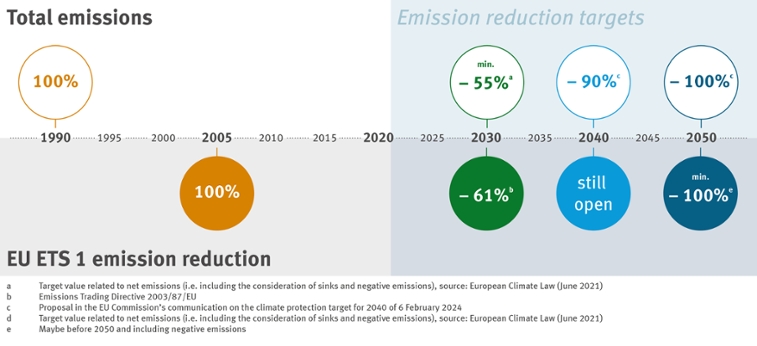
The EU has agreed to achieve climate neutrality within the EU by 2050 and to align European climate policy accordingly. The emissions reduction target for 2030 has been raised from 40 percent to at least 55 percent compared to the 1990 level. Both targets are enshrined in law in the European Climate Change Act. The climate protection target for 2030 and the roadmap for achieving climate neutrality were also submitted to the UN Climate Change Secretariat as a national reduction contribution and long-term strategy under the Paris Agreement.
The EU climate target up to 2040 is currently being discussed. The EU Climate Law obliges the European Union to propose this reduction target. It is publication of 02/07/2025, the European Commission (COM) therefore formulated a greenhouse gas (GHG) reduction target of 90 percent compared to 1990 for the year 2040. In contrast, the UBA recommends a more ambitious target of 95 percent GHG reduction compared to 1990.
Publications


Adjusting the Cap up to 2030
The reforms of the ‘Fit for 55’ package have aligned the EU ETS 1 with the aim of reducing emissions by around 62 percent by 2030 compared to 2005 levels. This will contribute to the new EU climate protection target of at least a 55 percent reduction in greenhouse gas compared to 1990 levels. This will include all stationary sectors as well as aviation and maritime transport therefore adjusting the cap in EU ETS 1 accordingly. An early and ambitious cap adjustment is important. The aim is to achieve climate neutrality for the economy as a whole by the middle of the century at the latest. In addition, cumulative emissions should be kept as low as possible.
It is important to adjust the cap early and ambitiously, as macroeconomic climate neutrality is to be achieved by the middle of the century at the latest. In addition, cumulative emissions should be kept as low as possible.
The linear reduction factor increases from 2.2 percent to 4.3 percent in 2024, and will increase to 4.4 percent in 2028 again. It is determined as a proportion of the average number of allowances allocated in the second trading period (2008 to 2012) which means an annual reduction of 84 million EUAs in 2024 to 2027 and each 86 million annually from 2028 onwards (including maritime transport in each case). In addition, extraordinary cap reductions are planned in 2024 (90 million allowances) and 2026 (27 million allowances) to bring the cap onto a linear emissions reduction path from 2021. In return, the cap will be slightly increased to take account of the inclusion of maritime transport in the EU ETS 1.
Publications


Offer Management through the Market Stability Reserve
The introduction of the Market Stability Reserve (MSR) in conjunction with the gradual lowering of the cap has helped to reduce the surplus on the carbon market and restore confidence in the steering function of the EU ETS 1.
The basic structure of the MSR has been retained during the reform of EU ETS 1. However, individual parameters have been adjusted. For example, the calculation of the Total Number of Allowances in Circulation (TNAC) now also involves aviation and maritime transport allowances. The doubled withdrawal rate of 24 per cent will now be applied until 2030.
The existing thresholds (400 million and 833 million EUA) have been retained. However, a new special rule applies to TNAC values between 833 and 1,096 million: in this range, the auction volume will be reduced by exactly the amount corresponding to the difference between TNAC and 833 million allowances. This is intended to prevent the MSR from reducing the total number of allowances in circulation below the upper threshold of 833 million.
The number of allowances held in the MSR will be limited to a maximum of 400 million allowances in the future. In 2023, around 2.5 billion EUAs were for the first time cancelled from the MSR; further cancellations on a smaller scale are expected in subsequent years.

